
The Four Stages of Toilet Learning
This article discusses the four stages and transitions of toilet learning and why each stage is important.
Elimination communication is making a comeback in Western countries, with diaper companies more recently releasing trainer pants to support the transition toward toilet independence. Elimination communication may be a newer name, but the method to assist a baby with their elimination requirements has been done throughout history.
After the world wars, there was a shift away from infant potty learning. It was a time of progress for women, with women entering the workforce, but a move away from some instinctual, natural techniques for babies. Bottle feeding was heavily promoted to women during this time. During the 1950s the La Leche League was formed to encourage and help mothers with breastfeeding. Gerber promoted feeding solids to babies from as young as 4 to 6 weeks.1 However, pottying babies changed in the West and developed a more relaxed attitude. These days, it is common for toilet training to be delayed until a child is 3 to 4 years of age, sometimes older. With the delay and prolonged diaper use, a number of issues can occur such as:
- Urinary tract infections2
- Diaper rash, including Staphylococcus aureus (MRSA) skin and soft tissue infections3
- Stool withholding
Stage 1: Holding Baby Out
The baby cannot sit, is on a liquid diet and is assisted in eliminating in a held squat position over a potty. The old term for this is ‘held out’. The baby does instinctively eliminate when in this hold and can show signals when they need to eliminate. The EC hold is a deep squat and a very advantageous position for passing stool.
Why This Stage Is Important
- Reduces the risk of diaper rash, diaper dermatitis and napkin rash
- Reduces the risk of soft tissue infections and MRSA3
- Helps communication and trust-building between baby and parent
- Responds to natural elimination patterns
- Results in a cleaner and healthier practice
- Maintains and develops sphincter control from a young age
- Supports the baby’s instinctual preference to eliminate outside clothing or bedding
- Teaches correct potty use
- Uses diapers as a backup rather than as the primary toilet
The use of a diaper forms a habit that must otherwise be unlearned.
Stage 2: The Sitting Potty Stage
The baby can sit unsupported and is eating solid foods. Once a baby can sit without being supported, they can control and coordinate their bladder, urethral sphincter and anal sphincter muscles.2
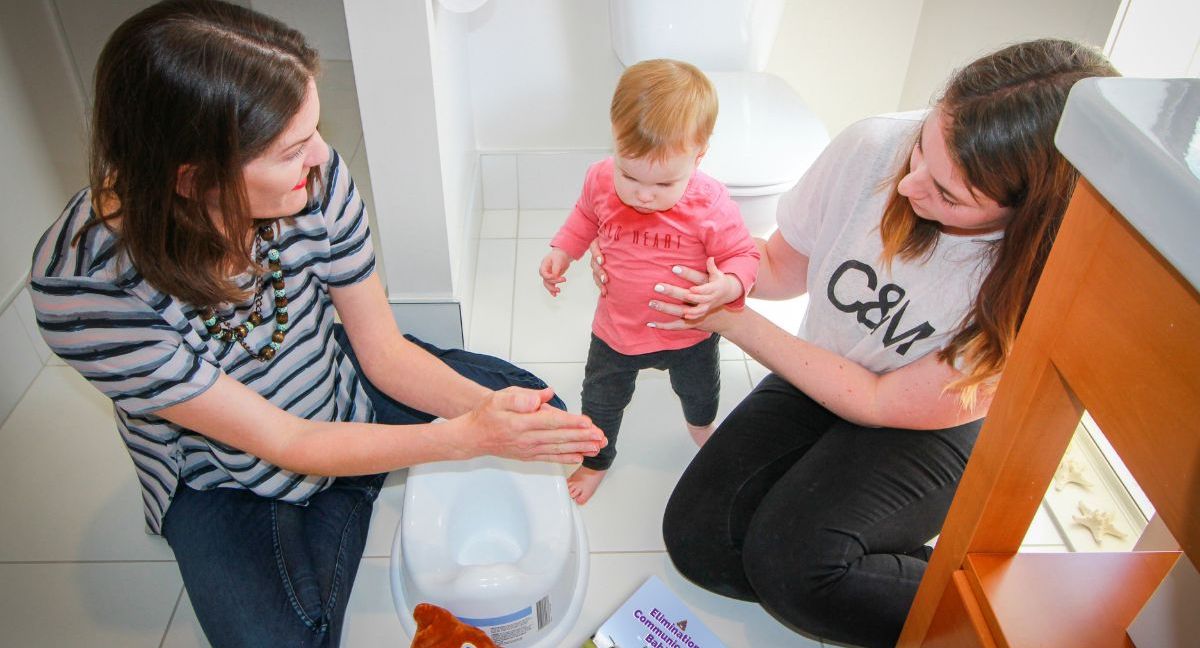
The potty is used as an accessible, safe option during this stage and encourages a squat sitting position.
Why This Stage Is Important
- Encourages healthy stool elimination
- Supports early toilet independence
- Allows baby to get onto and off the potty independently
- Introduces the toilet for some children
- Develops a regular elimination routine
- May help avoid urinary tract infections2
Stage 3: Toilet Independence (AKA Toilet Training)
The toddler can walk and communicate. This final stage progresses the child through using the toilet assisted to non-assisted, where the child can state their need to go toilet before they go. For elimination communication children, this final stage focuses on bladder control and recognizing their need to use the toilet. The bladder can now hold more, and the frequency of urination is less. For children starting their toilet learning here, the process of stool management sometimes follows bladder control. Privacy and independence become important for a child as they become more self-aware.
Why This Stage Is Important
- Completes the journey to toilet independence
- Removes the diaper safety net
- Builds bladder awareness and control
- Encourages independent toileting
A study into completed toilet training found average daytime dryness and bowel control were achieved at 17.4 months and 15.0 months respectively. Those who initiated toilet training during the first six months completed training earlier than those who started later.4
Stage 4: Nighttime Dryness
Nighttime assistance can occur during the first three stages or following. Nighttime dryness can be achieved earlier if started earlier. It’s fair enough to prioritize sleep though. You may wait until your child can walk and aid themselves to the toilet. While encouraging independence, you will still need to offer assistance and provide lighting and tools for their success. Aim to wrap up nighttime before too long, so night wetting does not become a habit. Deep sleepers may need nighttime assistance. Elimination Communication trained children are thought to have better awareness and control of the bladder, with more complete emptying. Anecdotally, they have less nocturnal enuresis (nighttime bedwetting).2
Don’t Miss the First Two Stages
Nowadays, many parents follow a method of delayed ‘toilet training’, skipping the first two important stages of toilet learning.
Here are the four stages that promote healthy, instinctual and normal elimination practice.
Ready to try EC?
Read How to Start Elimination Communication or the full What Is EC? primer, then browse our Guides by Age.
Written by Rebecca Larsen
Rebecca Larsen is Author of Elimination Communication Babies and EC Coach from New Zealand. Mother to two children, and a published Children’s book Author, Rebecca is passionate about sharing the positive benefits of Elimination Communication with families in a fun and easy read. Contact Rebecca for public speaking or media opportunities.
References
-
https://solidstarts.com/baby-led-weaning/history-of-baby-food/
-
Duong TH, Jansson UB, Holmdahl G, Sillén U, Hellström AL. Development of bladder control in the first year of life in children who are potty trained early. Journal of Pediatric Urology. 2010;6(5):501-505.
-
Bender J, She R. (2017). Elimination Communication: Diaper Free in America. Pediatrics. Official Journal of the American Academy of Pediatrics.
-
Rugolotto S, Sun M, Boucke L, Calò DG, Tatò L. Toilet training started during the first year of life: a report on elimination signals, stool toileting refusal and completion age. Minerva Pediatr. 2008;60(1):27-35.
Photos

Step-by-step guidance for elimination communication from birth to toilet independence.